Family Learning Assistant
A study plan that starts from one sentence. The agent handles orchestration; the rules stay in code.
The problem
When you use AI to learn something, the friction is rarely "I can't get an answer". It's that the material lives in PDFs and screenshots you can't revise from, that what you learned today is unfindable in three days, and that every tool needs the context explained again.
So the product's main line is not conversation — it is turning material into vocabularies and tasks. Chat is the entry point; the output is structured learning material.
The live product
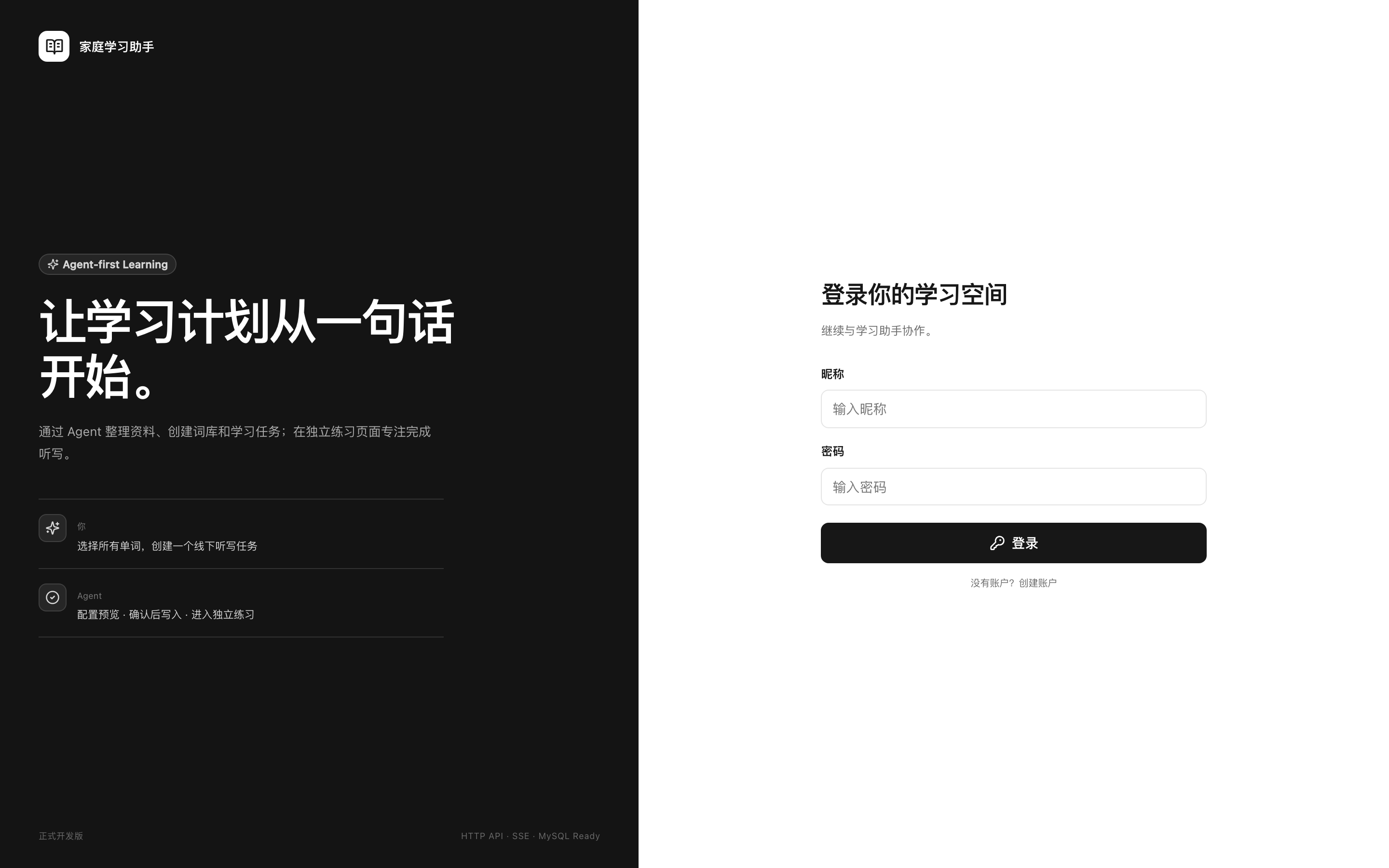

- Conversational intent parsing and tool orchestration
- Study-material parsing and term extraction
- Vocabulary creation and organisation
- Dictation task generation
- A dedicated practice page for dictation
- Human confirmation before create / update / delete
- Sign-in and per-user data isolation
Derived from the login page copy and the product's actual path; details behind the login are as the product has them.
Core flow
Step 3 is deliberate: terms extracted by the model only enter the store after a person confirms them, so wrong content never becomes study material.
Agent architecture
Schematic, to show layering and call direction; module names and details follow the code.
Engineering decisions
The agent never touches the database
The model writes no SQL and knows no table names. It can only choose which tool to call; the tool goes through the service layer.
The service layer is the only entry point
Business rules, permissions, transactions and state checks cannot be written or verified in a prompt. The backend is split into 11 domain modules, cross-module repository access is forbidden, and a dedicated user module owns authentication and data isolation.
Tool calling and workflow are separate jobs
Fixed order becomes edges; only semantics-dependent branches go to the model. One main agent, internal subgraphs, an LLM that only understands intent and picks tools.
Checkpoints, confirmation and recovery
LangGraph checkpointers let a long task resume from the last trusted state instead of restarting the whole chain; confirmation points show the result first, then execute, with idempotent side effects.
Stack
From zero to production
Moving from a Java backend to the AI agent stack, I designed and shipped this product alone: product definition, architecture, full stack and deployment. Everything that went wrong on the way — tool boundaries, context growth, state recovery, cost and latency — became 28 articles.